
Table of Contents
- Why a Used Box Truck Beats New for Most Small Businesses
- Box Truck Size Guide for Delivery: Matching Cargo Space to Your Routes
- How to Inspect a Used Box Truck Before Buying
- Commercial Truck Financing for Small Business: What to Expect
- Regulatory and Licensing Requirements for Box Truck Owners
- Upfitting and Retrofitting: Making a Used Box Truck Fit Your Business
- Which Used Box Truck Is Right for Your Small Business?
- Frequently Asked Questions
Last Updated: September 14, 2026
Why a Used Box Truck Beats New for Most Small Businesses
The best used box truck for small business is one that has already absorbed its steepest depreciation but still has years of service left in the chassis. At Routemaster, LTD, we’ve spent over 30 years watching small business owners make this exact decision.
New commercial vehicles lose a substantial chunk of value the moment they leave the lot. A used box truck sidesteps that hit entirely. You get the same cargo space, the same GVWR ratings, and the same daily utility for a fraction of the outlay, leaving capital free for insurance, fuel, and the tools that actually generate revenue.
The tradeoff is diligence. A used truck is only as good as its maintenance history, which is why a pre-purchase inspection matters more than any single spec on the listing.
Federal Motor Carrier Safety Administration guidance on commercial vehicle safety
Box Truck Size Guide for Delivery: Matching Cargo Space to Your Routes
The right box truck size for delivery depends on your heaviest regular load, not your average one. Sizing up “just in case” wastes fuel and maneuverability; sizing down means turning away jobs.
Common Box Truck Sizes and Dimensions
Most small business box trucks fall into three practical bands. A 10-12 foot box handles local courier runs and light furniture delivery. A 16-foot box is the workhorse for appliance, building supply, and e-commerce routes. A 20-26 foot box suits multi-stop freight where volume, not weight, is the constraint.
Match the box to your route profile before you match it to your budget. Tight residential streets punish long boxes. Highway freight lanes reward them.
Chassis and Cab Configurations
Box trucks come in two dominant cab layouts: conventional cab, where the engine sits ahead of the driver, and cab-over, where the driver sits above the front axle. Conventional cabs are easier to service and more familiar to most drivers. Cab-over designs shorten overall length, which helps in dense delivery zones.
Cutaway chassis, where a cab is mated to a purpose-built frame, dominate the light-duty box truck market. They’re cheaper to run and easier to upfit than heavier stripped chassis.
|
Box Size |
Typical Use Case |
Route Fit |
Payload Band |
|---|---|---|---|
|
10-12 ft |
Courier, light delivery |
Tight urban streets |
Light |
|
16 ft |
Appliances, e-commerce |
Mixed suburban |
Medium |
|
20-26 ft |
Multi-stop freight |
Highway, industrial |
Heavy |
How to Inspect a Used Box Truck Before Buying
Learning how to inspect a used box truck before buying is the single highest-return hour you’ll spend in the entire purchase. A methodical walkaround catches the problems that cost thousands later, and it separates a truck with real service life from one that’s been cosmetically refreshed for the lot.
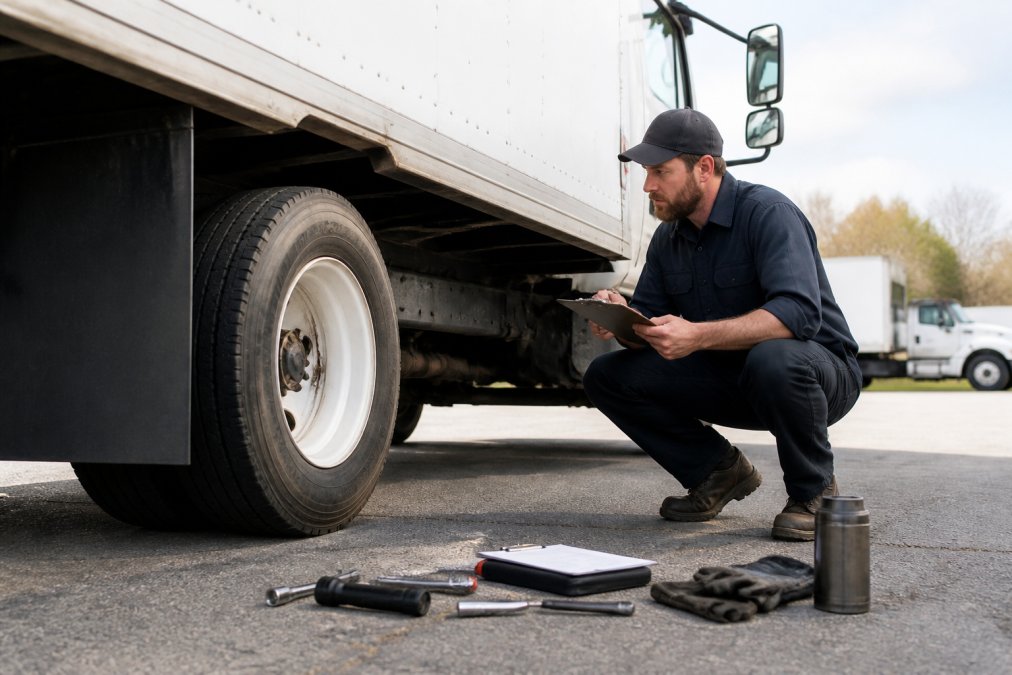
Start with the chassis and undercarriage, not the cab. Rust, frame cracks, and leaking seals tell you more about a truck’s real condition than a clean interior ever will. Bring a flashlight, a tire gauge, a creeper or cardboard to lie on, and a rag. Plan on 45 to 90 minutes per truck.
Pre-Purchase Inspection Checklist
Work through this list on every truck you seriously consider. Print it and take it to the lot.
Chassis and frame
- Check frame rails for cracks, rust-through, or prior welding, especially behind the rear axle and around the box mounts
- Look for fresh undercoating or paint over frame areas, which can hide rust-through
- Inspect the box-to-frame mounting brackets and U-bolts for looseness or corrosion
Box and cargo area
- Walk the box floor for soft spots; plywood or aluminum over a rotting subfloor is a common hidden cost
- Check the roof and side panels for water stains, delamination, or pinholes
- Test the roll-up or swing doors through a full cycle; check the track, rollers, and latch hardware
- Confirm the cargo security hardware and door seals
Lift gate (if equipped)
- Cycle the gate fully up and down under load, not empty
- Check the hydraulic reservoir, lines, and cylinders for weeping
- Verify the gate’s rated capacity plate matches your heaviest recurring load
Tires, brakes, and suspension
- Inspect tires for uneven wear, which signals alignment or suspension issues
- Check DOT date codes on all tires; tires older than about six to seven years warrant replacement regardless of tread
- Look at brake drum or rotor condition and pad or shoe thickness through the inspection holes
- Bounce each corner and check for leaking shocks or broken leaf springs
Engine, drivetrain, and fluids
- Look for oil or coolant seepage at the engine, transmission, and rear differential
- Check coolant, oil, and transmission fluid color and level
- Look for coolant residue around the water pump, hoses, and radiator seams
- Start the engine cold if possible and listen for injector knock or exhaust leaks
Cab, electrical, and paperwork
- Confirm all lights, brakes, turn signals, and the parking brake function
- Verify the odometer reading against service records
- Check the GVWR plate on the driver’s door jamb and confirm it matches the title and your licensing plan
- Confirm the VIN on the door jamb, title, and frame all match
Engine, Drivetrain, and Maintenance History
Engine hours matter as much as mileage on a box truck. A truck that idled for hours daily can show low mileage but heavy wear. Ask for the maintenance history in writing, and walk away from any seller who can’t produce it.
Diesel engines generally deliver better fuel efficiency and longer service life on heavier routes. Gas engines cost less to maintain on lighter, shorter runs. Match the engine type to your actual duty cycle.
A few model-specific patterns are worth knowing before you look:
- Ford E-Series and F-Series cutaways with the 5.4L or 6.8L V10 are common in the light-duty box truck market.
What a Bad Inspection Actually Costs
Commercial Truck Financing for Small Business: What to Expect
Budgeting for Total Cost of Ownership
Regulatory and Licensing Requirements for Box Truck Owners
CDL vs. Non-CDL: The 26,001-Pound Line
Endorsements and Additional Requirements
Operating Authority and DOT Numbers
Insurance and Registration
Upfitting and Retrofitting: Making a Used Box Truck Fit Your Business
Which Used Box Truck Is Right for Your Small Business?
Frequently Asked Questions
Which brand of used box truck is the most reliable?
Reliability depends more on maintenance history and engine hours than brand alone. Look for trucks with complete service records, diesel engines under 200,000 miles, and a clean pre-purchase inspection. Ford, Isuzu, and Freightliner are common in the used market, but a well-maintained truck from any major manufacturer will outperform a neglected one from a top brand. Always check the odometer reading, engine hours, and whether the GVWR matches your payload needs before committing.
What should I look for when inspecting a used commercial truck?
Start with the frame for rust or cracks, then check the box floor for soft spots and water damage. Test the lift gate, roll-up door, and cargo security features. Under the hood, look for oil leaks, coolant condition, and belt wear. Review the maintenance history for oil change intervals and major repairs. Take it for a test drive that includes highway speeds and tight turns. A pre-purchase inspection by a third-party mechanic is worth the cost for any used box truck you are serious about buying.
Is a used box truck a good investment for a small delivery business?
A used box truck can be a strong investment if you match the size to your routes and budget for total cost of ownership. Depreciation hits new trucks hardest in the first few years, so buying used avoids that initial drop. Factor in fuel efficiency, commercial insurance, maintenance, and financing options. A truck with 100,000 to 150,000 miles and a documented service history often delivers the best balance of upfront price and remaining vehicle longevity for a small business.
How do I finance a used box truck for my small business?
Commercial truck financing for small business typically comes through banks, credit unions, or specialty lenders. Expect to provide financial statements, tax returns, and a business plan. Down payments vary based on credit and truck age. Some lenders offer non-CDL truck financing with more flexible terms. Get pre-approved before you shop so you know your budget. Compare rates and terms from at least three lenders, and ask about prepayment penalties or hidden fees before signing.